June 24, 2026
Awarding Body vs Training Provider: Who Controls Quality?
In 2025 alone, over 7.14 million qualification results were issued in England across GCSEs, A levels and vocational and technical qualifications. Behind every one of those results is a system designed to maintain high standards, monitor assessment practice and protect the credibility of regulated qualifications.
That system involves far more than just teachers and assessors. Training providers, awarding bodies, quality assurers and regulators all work together to make sure assessment outcomes remain reliable across different centres. But where does the buck stop for quality control?
Training Provider vs Awarding Body: Quick Comparison
| Area | Training Provider or College | Awarding Body |
| Delivers teaching and training | Yes | No |
| Assesses learners | Yes | Sometimes |
| Creates qualifications | No | Yes |
| Sets qualification standards | No | Yes |
| Supports learners | Yes | No |
| Approves assessment centres | No | Yes |
| Carries out Internal Quality Assurance | Yes | No |
| Carries out External Quality Assurance | No | Yes |
| Issues certificates | No | Yes |
Who is responsible for quality in assessment?
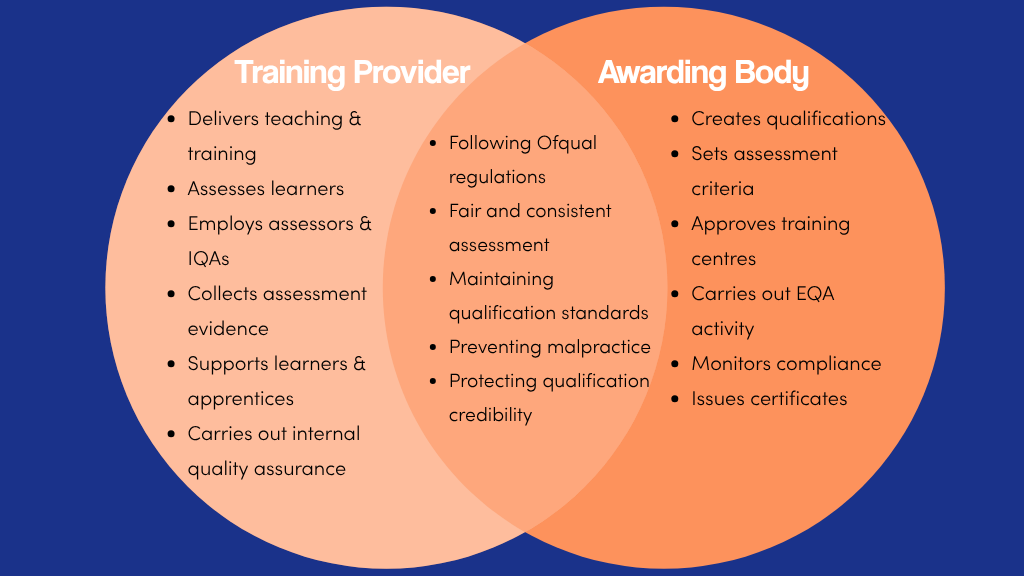
When learners receive a qualification, responsibility for the outcome doesn’t sit entirely with the assessor who marked the work. Training providers, awarding bodies, internal quality assurers (IQAs) and external quality assurers (EQAs) all work together to reduce the risk of inconsistent marking, poor practice or internal bias. Their roles are all different, but there is overlap in how they help reduce risk across the assessment process:
What is a training provider responsible for?
A training provider is an organisation that delivers teaching and learning, training or assessment to learners. They could include further education colleges, independent training providers, apprenticeship providers, adult learning centres or training departments in firms.
A training provider’s responsibilities can include:
- delivering teaching and practical training
- assessing learners against assessment criteria
- preparing learners for examinations and workplace assessments
- supporting apprentices and vocational learners
- looking after learner records and assessment evidence
- Hiring and retaining skilled assessors and IQAs
- standardising assessment practice so all their staff are assessing correctly
What does an awarding body do?
An awarding body is responsible for creating qualifications, setting assessment standards and monitoring approved centres that deliver those qualifications. In England, awarding bodies are regulated by the Office of Qualifications and Examinations Regulation (Ofqual) to make sure qualifications remain consistent and credible across the sector.
Some of the best-known awarding organisations include City & Guilds, Pearson and Cambridge OCR. These organisations work with schools, colleges, apprenticeship providers, private companies and training providers across a wide range of subject areas. Many awarding bodies develop qualifications listed by Ofqual on the Regulated Qualifications Framework (RQF).
While a training provider delivers the learning, the awarding body controls and regulates the qualification itself. Awarding bodies are responsible for:
- designing qualification content and assessment criteria
- setting learning outcomes and grading requirements
- approving training providers and assessment centres
- monitoring assessment quality at these centres through EQA activity
- updating qualification requirements when standards change
- issuing certificates to successful learners
Awarding bodies also uphold public confidence in accredited qualifications. Employers, universities and regulators need to know that learners are being assessed consistently, regardless of where they studied.
This is why awarding organisations carry out regular monitoring of centres. If assessment practice falls below the required standard, awarding bodies can order centres to make direct improvements, increase monitoring or, in serious cases, remove a centre’s approval altogether.
Internal Quality Assurance vs External Quality Assurance
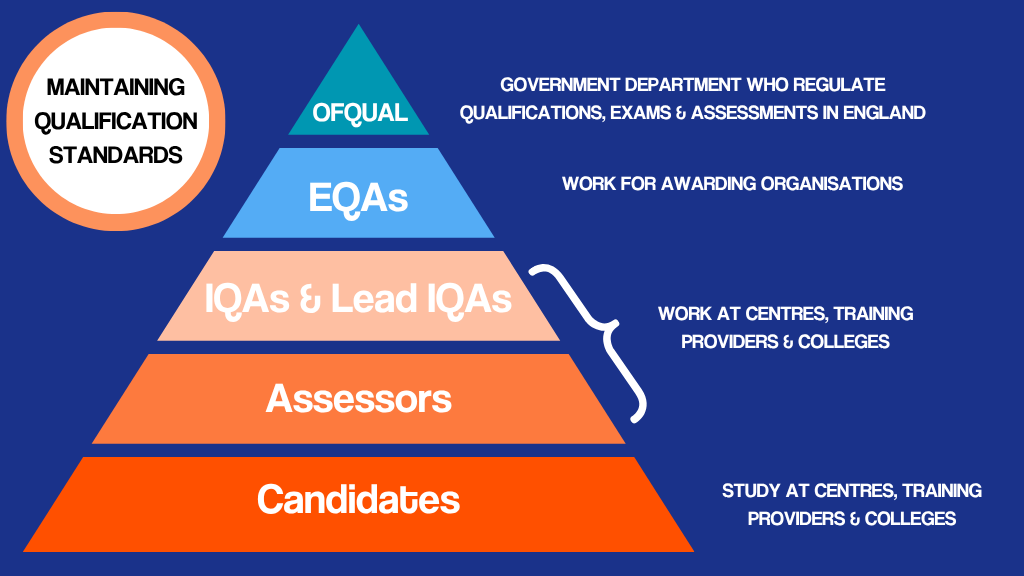
As centres start operating, quality assurance becomes an ongoing process. This is where internal quality assurance and external quality assurance come in.
Both roles support reliable assessment practice, but they work at different levels.
Internal Quality Assurance
Internal quality assurance takes place at approved centres. An IQA is responsible for monitoring assessment judgements and supporting assessors to ensure assessment criteria are interpreted correctly across the organisation.
Typical IQA responsibilities include:
- sampling learner work and looking at assessment decisions
- checking assessment records and feedback
- supporting and standardising assessor practice
- identifying areas where assessors may need further support, advice or training
- preparing for EQA visits
External Quality Assurance
External quality assurance sits outside the training provider. External quality assurers (EQAs) work for awarding bodies and they monitor approved centres to make sure regulated qualifications are being delivered in line with awarding body requirements.
An EQA work includes:
- reviewing assessment and IQA records
- sampling learner evidence
- observing assessments
- checking compliance with awarding body requirements
- identifying risks or malpractice concerns
- setting actions plan for centres to complete
What happens if a training provider fails quality checks?
Together, IQAs and EQAs help create consistency across the education and training sector. Without these roles, assessment standards could vary significantly between centres, which would reduce confidence in qualifications and create unfair outcomes for learners.
When compliance checks identify concerns or malpractice, the response will depend on how serious the issue is and how quickly the provider resolves it.
Minor issues may result in recommendations or action plans. More serious concerns can lead to increased EQA monitoring, additional quality assurance visits or restrictions on learner registrations and awards.
In severe cases, an awarding body can suspend or remove centre approval altogether, meaning the provider can no longer deliver qualifications.
Why Qualified Assessors & IQAs Matter
One of the biggest risks in assessment is inconsistency. Without proper quality assurance processes, learners could receive different assessment outcomes depending on who assessed them, where they studied or how evidence was interpreted.
Having qualified assessors and IQAs in place helps reduce the risk of internal bias and inconsistent assessment judgements. Assessors are expected to apply professional judgement consistently while working to awarding body requirements. They are responsible for judging learner competence against qualification standards, while IQAs monitor those decisions internally to make sure standards are being applied fairly across the organisation.
This process helps identify issues such as:
- assessors interpreting criteria differently
- overly lenient or harsh assessment outcomes
- inconsistent feedback to learners
- gaps in assessment evidence
- poor assessment record-keeping
These responsibilities carry significant weight. Assessment decisions can affect career progression, apprenticeship completion, access to further education and professional credibility. Poor assessment practice can damage confidence in qualifications and create wider quality concerns for training providers and awarding bodies.
This is why assessors and IQAs are expected to be highly skilled, properly trained and capable of applying standards consistently. Professionals working in these jobs also need a clear understanding of assessment methods, evidence requirements, standardisation and quality assurance procedures. For this reason, many providers and awarding bodies expect assessors and IQAs to hold recognised qualifications. The Level 3 Certificate in Assessing Vocational Achievement (CAVA) is one of the most widely recognised assessor qualifications, while professionals moving into internal quality assurance often complete a Level 4 IQA qualification.
Starting a Career in Assessment & Quality Assurance
For many professionals already working in education or industry training, assessment and quality assurance are a route into more senior responsibilities. It is common to progress from assessor roles into IQA positions and, later, into EQA or wider quality management posts.
The qualification you need will usually depend on the type of job you want to move into. The Level 3 Certificate in Assessing Vocational Achievement (CAVA) is one of the most widely recognised assessor qualifications in the UK, while Level 4 IQA and EQA qualifications support progression into internal and external quality assurance roles.
If you’re ready to move into assessment or quality assurance, explore Carlton Training’s assessor, IQA and EQA qualifications and book your place today.
Next ›‹ Previous
Back to Blog