June 10, 2026
Fair Assessment: Lessons From The 2026 A Level Maths Paper Petition
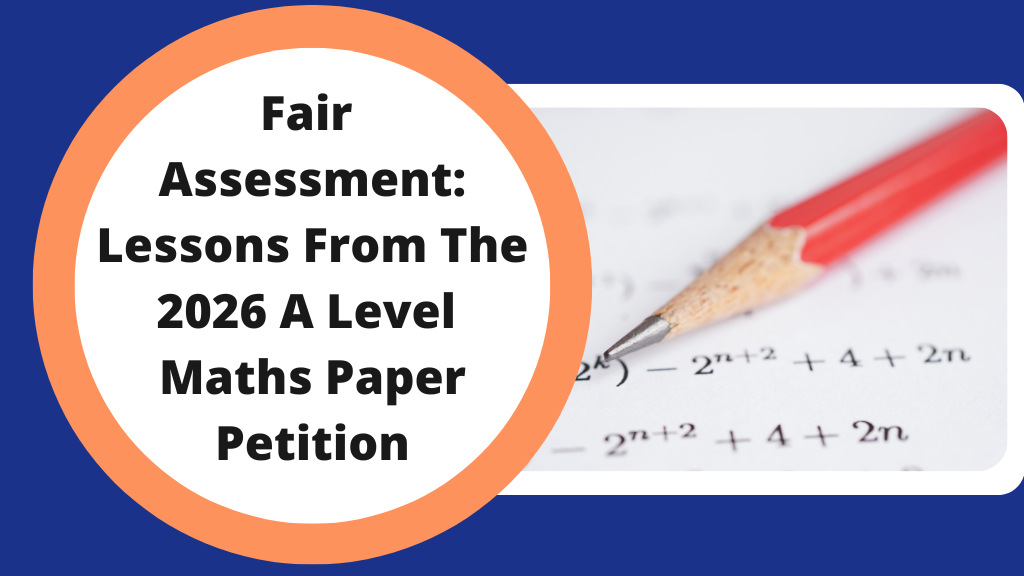
Thousands of people are currently backing a petition over Pearson Edexcel’s 2026 A-level Maths Paper 1, after many described the exam as unusually difficult.
A-level Maths is one of the UK’s biggest post-16 subjects, with entries rising from 107,427 to 112,138 in the latest figures. When a paper causes this much concern, it affects a large group of students, schools and families.
A hard exam is not automatically an unfair exam. A-level Maths is meant to test problem-solving, reasoning and subject knowledge under pressure. But when so many students question the same paper, it raises a wider issue: what makes a fair assessment?
Why are UK students petitioning over the 2026 Maths A-level paper?
Students are petitioning because many believe Pearson Edexcel’s 2026 A-level Mathematics Paper 1 was much harder than expected.
The maths exam was sat on Wednesday 3 June 2026. Since then, pupils, parents, teachers and tutors have raised concerns that the paper included demanding multi-step questions, unfamiliar approaches and sections that became difficult to access if an earlier part of a question could not be completed. By 9 June, the maths A-level petition had gained over 33,000 signatures.
The petition isn’t asking for automatic extra marks, special treatment or an easier exam. The main argument is that the 2026 paper felt out of line with recent past papers, and that any difference in difficulty should be reflected fairly in the grades.
A lot of the concern centres on access for the wider cohort. Some candidates felt the paper favoured students who could spot less familiar methods quickly under heavy time pressure, rather than giving well-prepared students enough room to show what they could do.
Pearson has said that its papers are developed with input from senior examiners and checked against the required standards. It has also said that if an examination paper is found to be more difficult than previous years, grade boundaries will be set to reflect that, using statistical data and expert judgement.
That is where this story becomes bigger than one exam paper. The real issue is not only how difficult the questions were, but how fairness is checked, explained and protected once concerns are raised.
What is a fair assessment in education?
A fair assessment judges learners against clear standards in a consistent way. It should test the knowledge, skills or understanding it is meant to test, without giving some learners an unfair advantage or disadvantage.
This doesn’t mean every learner will find the assessment comfortable. Some will find it harder than others. That is normal, especially in high-stakes situations like A-level Maths. The question is whether the assessment gives learners a reasonable chance to show what they know and can do.
In education, fairness depends on several things working together:
✓ The assessment needs to match the qualification level (i.e. what level of knowledge or skill is expected,e.g. an A-Level will be at a much higher level than a GCSE)
✓ The assessment methods need to be suitable for the subject
✓ Marking needs to be consistent across learners, locations and dates
✓ Results need to show a fair outcome across the full group of learners
Why Exams Alone Can Be Unfair
One issue this debate brings into focus is whether a single exam should carry the full weight of assessment.
Exams can be useful. They test knowledge under timed conditions and can help compare performance across a large group of learners. But using exams as the only method of assessment can be fundamentally unfair, especially when a learner’s future depends on one paper, on one day.
A single exam may not show the full range of what a learner knows or can do. Some students may understand the subject well but struggle with the format, timing, pressure or wording of the paper. Others may be affected by illness, anxiety or personal circumstances such as disabilities. When there are no other forms of evidence, there is less room to build a fairer picture of the learner’s ability.
This is why many vocational and workplace-based qualifications use a mix of assessment methods. These may include practical tasks, observations, portfolios, professional discussions and written work. Each method gives the learner a different way to show their knowledge, skills and understanding.
That doesn’t mean exams have no place. The issue is relying on them alone. A fair assessment system should use the right method for what is being tested, rather than assuming one written exam can measure everything.
Why Difficulty Is Not the Same as Unfairness
A difficult assessment is not automatically unfair. In many subjects, challenge is part of the design.
A-level Maths is expected to test more than memory. Students need to apply methods, interpret unfamiliar problems and decide which techniques to use under timed conditions. This means some questions will feel demanding.
The fairness question is not simply “Was the paper hard?” A better question is: “Was the paper hard in the right way?”
An assessment can stretch strong students while still giving others enough opportunity to pass. It should test the learning outcomes at the right level, use clear wording and allow students to show partial understanding or achievement where they can.
Unfairness becomes a concern when the challenge stops assessing the intended skills. That could happen if wording is unclear, the structure of a question blocks access to later marks or the overall level sits too far from what students could reasonably expect from the qualification specification or syllabus.
This is why petitions like this matter. They don’t prove that an exam was unfair, but they do show where confidence in the assessment process has been shaken.
What makes an assessment fair?
Clear Standards
A fair assessment starts with clear standards. Before any assessment takes place, the assessor or examiner needs to know exactly what is being judged. For a qualification, this usually means working from the specification, learning outcomes or assessment criteria set by the Awarding Organisation.
Learners should also know what they are being assessed against. In qualification terms, this usually means being made aware of the relevant learning outcomes and assessment criteria before the assessment takes place.
If candidates do not understand what knowledge, skills or standards they are expected to demonstrate, it becomes much harder for them to prepare properly. That creates a weakness in the system because learners may be tested against unknown criteria.
Valid Tasks or Activities
The task itself also needs to be valid. In simple terms, it should test the right thing. If an exam is designed to assess mathematical reasoning, the questions should give students a fair chance to show that reasoning. If a vocational assessment is designed to check practical competence, the evidence should come from a suitable task or workplace activity.
Consistent Judgement
Learners should not be judged differently because of who marks their work, where they study or which assessment date they have. This is why marking schemes, standardisation, internal quality assurance and external quality checks are so important.
Fair Access
Fairness in assessment also means recognising access. Learners should understand what is being asked of them, even when the task is challenging. Clear instructions, suitable wording and well-planned assessment methods all help reduce unnecessary barriers.
Decisions That Can Be Explained
A fair assessment is not one where everyone passes. It is one where the result can be trusted because the process was planned properly, the evidence was judged against the right standards and the decision can be explained.
Fairness Continues After the Assessment
For fair assessment, this matters. A fair result is not based only on the questions or tasks learners face on the day. It also depends on the checks that happen afterwards to make sure results reflect performance, standards and the performance of learners.
The petition also asks for transparency around how grades are decided. That is important because trust in assessment depends not only on fair decisions, but on learners understanding how those decisions are reached.
Whose job is it to make sure assessments are fair?
Making sure assessments are fair is a shared responsibility between awarding organisations, examiners, markers, moderators, assessors, IQAs and EQAs:
Awarding Organisations
For written exams, awarding bodies like Pearson are responsible for setting papers, checking that questions match the specification and making awarding decisions. Senior examiners, markers and awarding teams all play a part in making sure the paper is assessed consistently and that final grades are set fairly.
Examiners, Markers and Moderators
In exam-based qualifications, trained examiners and markers apply the mark scheme so students are judged consistently. Moderators may also be involved where assessment includes coursework, practical work or centre-marked components. Their job is to make sure standards are applied fairly across different schools and colleges.
Assessors
Assessors are more common in vocational qualifications, apprenticeships, workplace training and practical courses. They judge learner evidence against the required standards. This may include looking at practical tasks, portfolios, witness statements, professional discussions and observing learners in a workplace or simulated setting.
A good assessor plans suitable assessment activities, uses the right methods, avoids bias and keeps clear records. Their work helps learners prove what they know and can do in a structured way.
Internal Quality Assurers
Internal Quality Assurers, often called IQAs, are usually found in vocational and training settings. They check that assessors are making consistent decisions within the centre. They may sample assessment records, review feedback and support assessors with standardisation so that they are all working to the same standard.
External Quality Assurers
External Quality Assurers (EQAs) look at the centre’s wider assessment and quality systems on behalf of the awarding organisation. Their role helps protect standards across different centres and providers.
What The A-level Maths Petition Shows About Trust in Assessment
The A-level Maths petition shows how quickly trust can be tested when learners feel an assessment doesn’t match what they were prepared for.
Students may not understand every stage of paper setting, marking and awarding, but they do understand the impact of a result. If thousands of students report similar concerns around time pressure, accessibility and consistency, they will expect those concerns to be reviewed properly.
That doesn’t mean online reaction should decide the outcome. But transparency matters. When learners understand how an assessment is created, how grades are decided and how fairness is protected, they are more likely to trust the final result.
Interested in assessment as a career?
Clearly, assessment decisions matter. The comments on the petition give a clear insight into the anxiety this exam has caused for the students who sat it, from fears about missing university entry requirements to concerns over apprenticeship opportunities and future jobs.
Behind every fair result, there are people responsible for setting standards, judging evidence, checking quality and protecting trust in the process. Assessment can be a rewarding career path for people who want to use their subject knowledge to support learners and maintain high standards across education and training.
If you’re interested in moving into assessment, Carlton Training offers online and in-person assessor and quality assurance courses. These include qualifications for new assessors, experienced assessors moving into internal quality assurance and those looking to progress into external quality assurance.
Explore our assessment and quality assurance courses to find the right route for your next step, then book your place online.
Next ›‹ Previous
Back to Blog