July 15, 2026
Why Preventing Malpractice In Education Matters
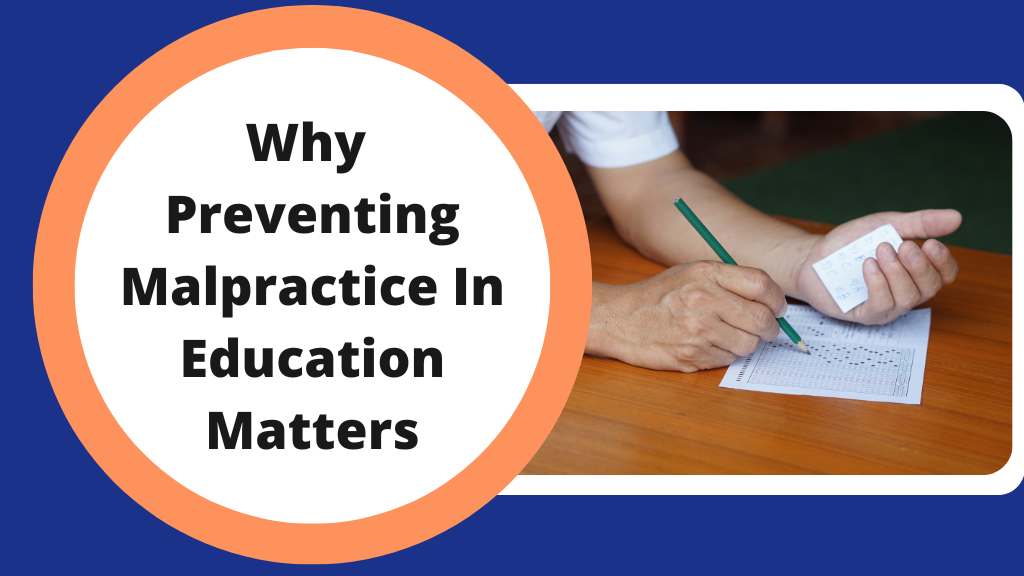
In summer 2025, Ofqual recorded 5,025 student malpractice cases across GCSE, AS and A-level exams. That means thousands of learners received penalties for actions that put their results, progression and future plans at risk.
Malpractice in education is not only a learner issue. It can involve staff, assessment records, centre processes, weak invigilation, poor evidence checks and unclear quality assurance.
For schools, colleges and training providers, prevention has to be built into everyday practice. Clear rules, trained staff, fair assessment decisions and strong IQA processes all help protect learners, centres and the value of the qualifications being delivered.
What is malpractice in education?
Malpractice in education is any action that could undermine the fairness, security or validity of an assessment. In simple terms, it means something has happened that could make a result unreliable.
It can be deliberate, such as cheating, collusion or falsifying evidence. It can also occur through poor practice, like inadequate supervision, weak record-keeping or staff failing to adhere to awarding organisation requirements.
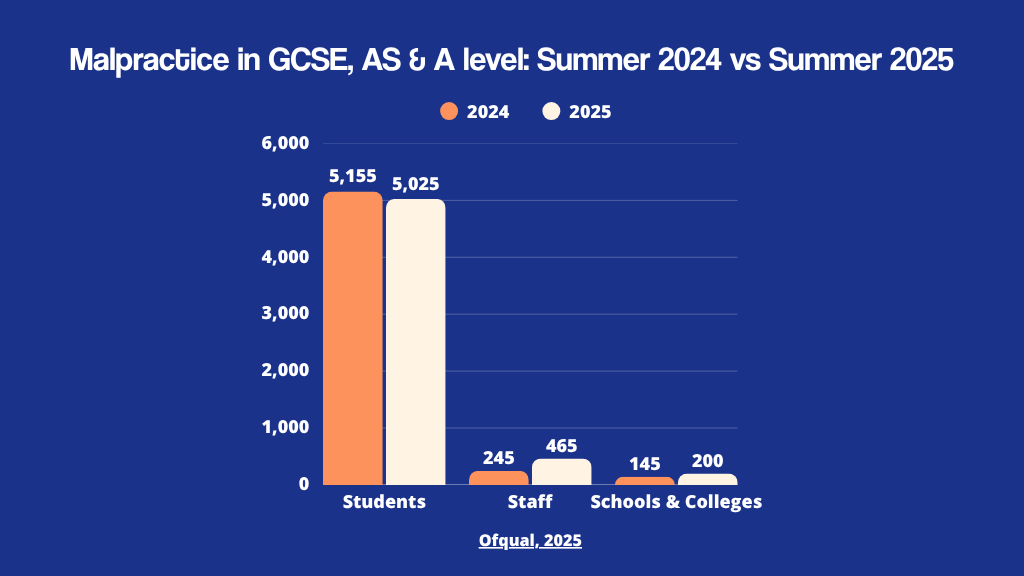
Ofqual’s summer 2025 report shows that malpractice is not limited to learners. Alongside the 5,025 student malpractice cases, there were 465 staff malpractice cases and 200 school or college malpractice cases with penalties issued.
That matters because qualifications depend on trust. When a learner is awarded a result, employers, colleges, universities and awarding organisations need confidence that the learner has met the required standard.
Types Of Malpractice In Education
Malpractice in education can take many forms. Some cases are obvious, like a learner using a phone during an exam. Others are less visible, especially when they involve assessment evidence, staff judgement or centre processes.
Learner Malpractice
Learner malpractice happens when a learner breaks assessment rules or gains an unfair advantage. This can include:
- Taking a mobile phone, smartwatch or unauthorised material into an exam
- Copying from another learner
- Plagiarism
- Using AI tools when the assessment rules don’t allow it
- Submitting work completed by someone else
- Falsifying evidence in a portfolio
- Disrupting an assessment
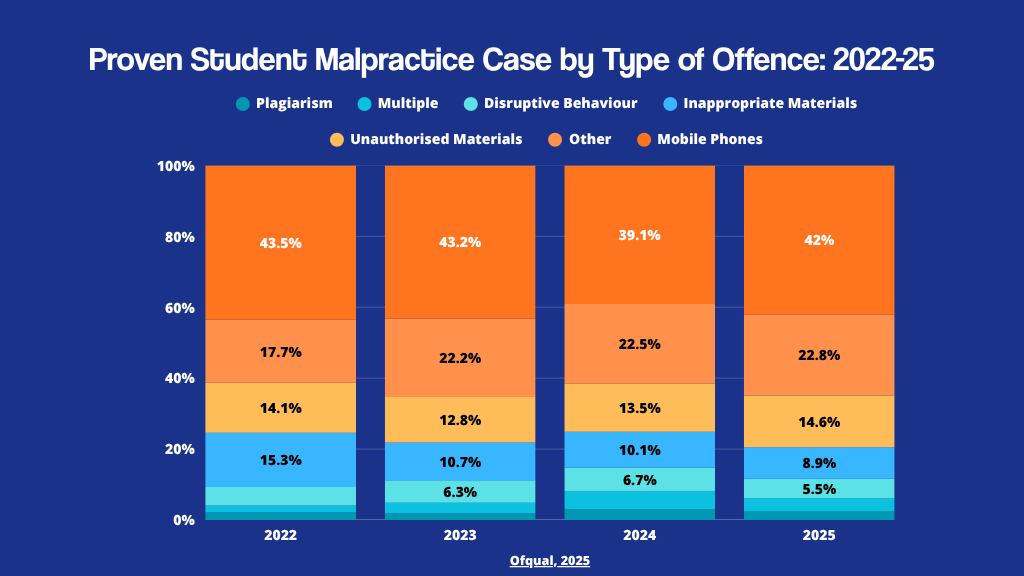
Mobile phones and smart devices are one of the biggest issues. In summer 2025, Ofqual reported that mobile phones and other communication devices appeared in 42% of proven student malpractice cases. AI misuse is also becoming harder to ignore. In summer 2025, plagiarism involving the misuse of AI accounted for 75.0% of all student plagiarism cases, compared with 55.4% in summer 2024. In real terms, that was 100 AI-related plagiarism cases in 2025, up from 85 the year before.
For education providers, this shows the importance of clear learner guidance. Secondary school students, apprentices and learners in higher education all need to understand what counts as independent work, how AI tools can and can’t be used and what may happen if they treat assessment rules as a shortcut.
Staff Malpractice
Staff malpractice can involve teachers, trainers, assessors, invigilators or other centre staff. This may include giving learners too much help, sharing confidential assessment materials, failing to follow assessment rules or marking work unfairly.
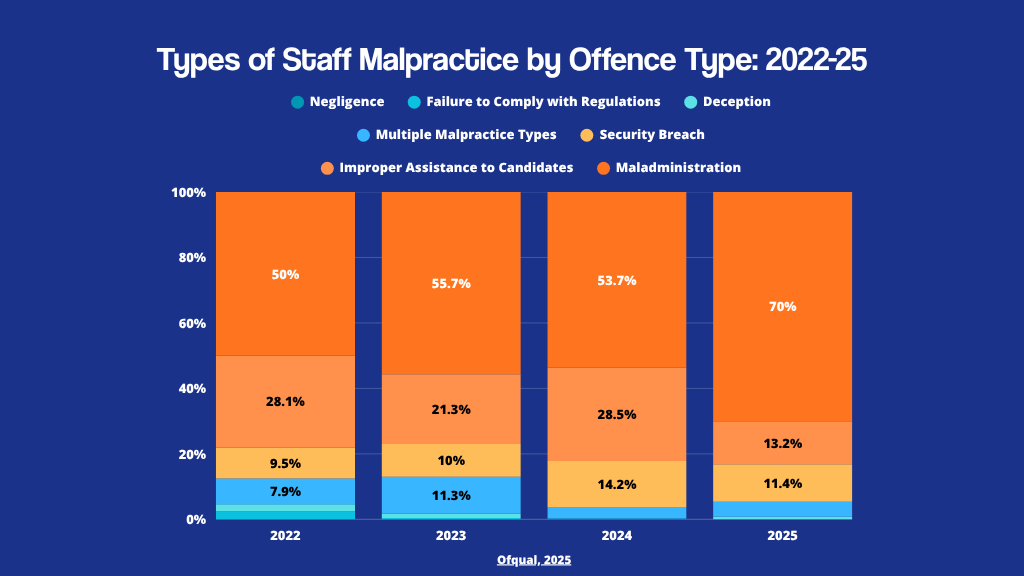
In 2025, 70.0% of proven staff malpractice cases by offence type were recorded as maladministration. This shows that the biggest staff-related risk is often not deliberate dishonesty, but poor processes, unclear responsibilities, gaps in training or misunderstanding assessment and exam rules.
That doesn’t make the issue harmless. A missed process, poorly handled assessment or incorrect piece of support can still affect results, learner fairness and centre compliance. Staff need to understand the line between professional support and unfair assistance.
Centre Malpractice
Centre malpractice happens when the problem sits at the school, college or training provider level. This could involve weak assessment systems, poor internal checks, insecure handling of assessment materials or a failure to investigate concerns properly.
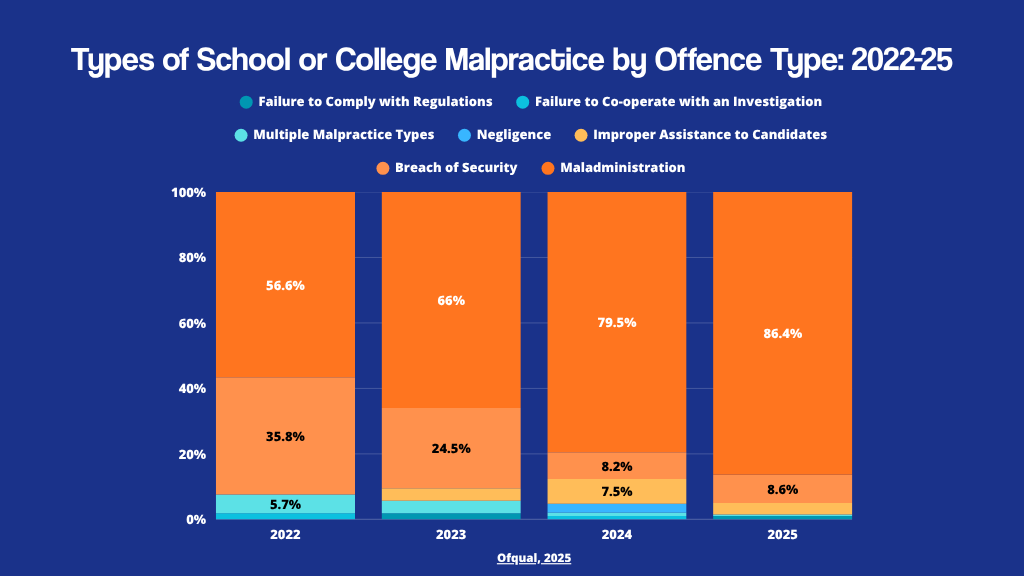
In 2025, 86.4% of proven school or college malpractice cases by offence type were recorded as maladministration. This shows that centre-level malpractice is often linked to how assessment is managed day to day, rather than deliberate wrongdoing.
The impact can still be serious. If staff are unclear on the rules, evidence is not checked properly or IQA sampling becomes a tick-box task, the risk can spread across learners, departments and qualifications. Centres can reduce this risk by building malpractice awareness into staff training, assessment planning, standardisation and quality assurance.
The Consequences of Malpractice Claims
A malpractice claim can have serious consequences, even before a final decision is made. Investigations take time, create pressure and can affect confidence in the assessment process. If malpractice is proven, the penalties can be much more severe.
Consequences For Learners
Learners may receive a warning, lose marks or lose the chance to complete part of their qualification. In serious cases, this can affect college places, university applications, apprenticeships or employment plans.
Consequences For Staff
For staff, malpractice claims can put professional judgement, records and assessment decisions under scrutiny. If malpractice is proven, penalties may include warnings, extra training, special conditions or suspension from assessment duties.
Consequences For Centres
Centres may be asked to review their procedures, report back on improvements, accept extra monitoring or work with restrictions on assessment materials. A malpractice claim can also affect how learners, parents, employers and awarding organisations view the centre.
Wider Consequences
Qualifications need to be trusted. If malpractice is not prevented, unfair results can affect employment, progression and public confidence in education and training.
How Education Providers can Prevent Malpractice
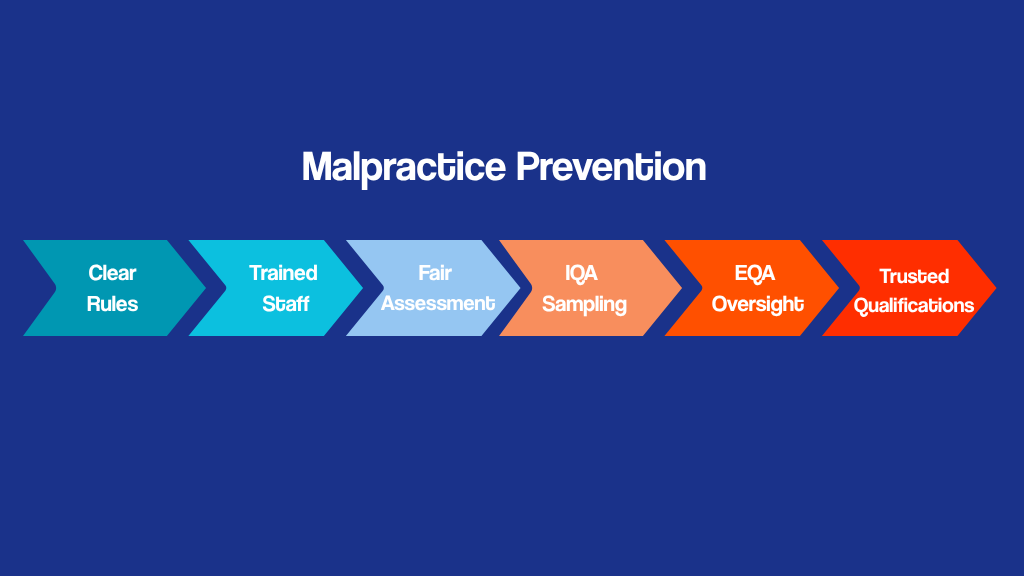
Preventing malpractice starts long before an examination, assessment or portfolio review takes place. It depends on clear expectations, trained staff and quality checks that are used throughout delivery. It is a shared responsibility made up of many roles, and it has many moving parts.
Policies matter, but staff need to know how to put them into practice. Teachers, trainers, assessors, IQAs and managers should understand assessment rules, evidence requirements, professional boundaries and reporting procedures. Without that shared understanding, poor practice can repeat until it becomes a formal allegation.
The Role of Assessors in Preventing Malpractice
Assessors are often the first people who can spot a malpractice risk. They work directly with learners, review evidence and make decisions against the assessment criteria, so their records and judgment need to stand up to scrutiny.
Good assessment practice starts before the assessment takes place. Assessors need to understand the qualification criteria, choose suitable assessment methods and explain the rules clearly to learners. This includes what support is allowed, what counts as independent work and how evidence should be produced.
During assessment, assessors need to be clear about where support stops and assessment begins. Feedback should explain the result and help learners understand what to do next, but it should not guide them through the task, correct their answers or improve their work while the assessment is taking place.
Accurate records are also important. Assessment decisions should show what evidence was reviewed, why the learner met the criteria and any actions needed if the learner was not yet competent.
When assessors are properly trained, they are better able to spot weak evidence, question anything that doesn’t feel right and report concerns early. This helps prevent malpractice before it becomes a bigger problem for the learner, the assessor or the centre.
The Role of IQAs in Reducing Malpractice Risks
Internal Quality Assurers reduce malpractice risks by checking how assessment decisions are being made, recorded and sampled across the centre. Their work helps centres spot weak practices before they turn into formal malpractice allegations.
A strong IQA process looks beyond completed forms. It checks how assessors plan assessments, apply criteria, record decisions and confirm the authenticity of learner evidence. This is especially important in vocational assessment, where learners may submit workplace evidence, portfolios, witness statements or professional discussions instead of sitting a written examination.
IQAs also help assessors follow awarding bodies’ rules and regulations. If assessment practice is inconsistent, records are incomplete or staff are failing to adhere to centre procedures, the IQA should address this through sampling, feedback, standardisation and further training.
This is why IQA is not only a checking role. It gives assessors clearer guidance, helps learners receive fairer decisions and gives centres stronger evidence if their assessment practice is questioned by an EQA.
When IQA works well, it encourages vigilance without creating a blame culture. Staff become clearer on what good assessment conduct looks like, and the centre is less likely to let poor practice become a wider malpractice problem.
Where EQAs Fit into Malpractice Prevention
External Quality Assurers review how centres manage assessment and internal quality assurance. They are usually appointed by awarding bodies to check that qualifications are being delivered and assessed in line with the required standards.
An EQA may look at learner evidence, assessment records, IQA sampling, standardisation activity and staff competence. They may also check how the centre handles conflicts of interest, malpractice concerns and any previous actions raised during external quality assurance.
Their external view also helps protect the credibility of qualifications across different centres by identifying gaps that internal teams may have missed.
For assessors and IQAs, EQA activity should not be seen as something to fear. It is part of the quality cycle. When records are clear, staff are trained, and assessment decisions are supported by evidence, external quality assurance helps confirm that the centre is maintaining fair and reliable standards.
Together, these roles create the quality framework that helps centres prevent malpractice. Assessors make the decisions, IQAs check the consistency of those decisions and EQAs provide external oversight. For that system to work well, each person needs the right training, clear responsibilities and a practical understanding of their role.
Get Qualified with Carlton Training
Keep assessment standards high by making sure you and your staff have the right qualifications, practical skills and confidence to carry out your roles properly.
Carlton Training provides recognised assessor and quality assurance qualifications for people working across assessment, internal quality assurance and external quality assurance, including the Level 3 Certificate in Assessing Vocational Achievement (CAVA), the Level 4 Award in Internal Quality Assurance and the Level 4 Award in External Quality Assurance.
Our courses can be delivered online or in person and are designed around the needs of working people. You will receive tutor support, practical guidance and insight into the reality of keeping assessments fair, consistent and high quality in 2026 and beyond.
View our courses and book online or contact Carlton Training for advice on the right assessor or quality assurance course for your role.
Next ›Back to Blog